
Teaching Ourselves to See: A Direct Method for Denoising CRISM Hyperspectral Data
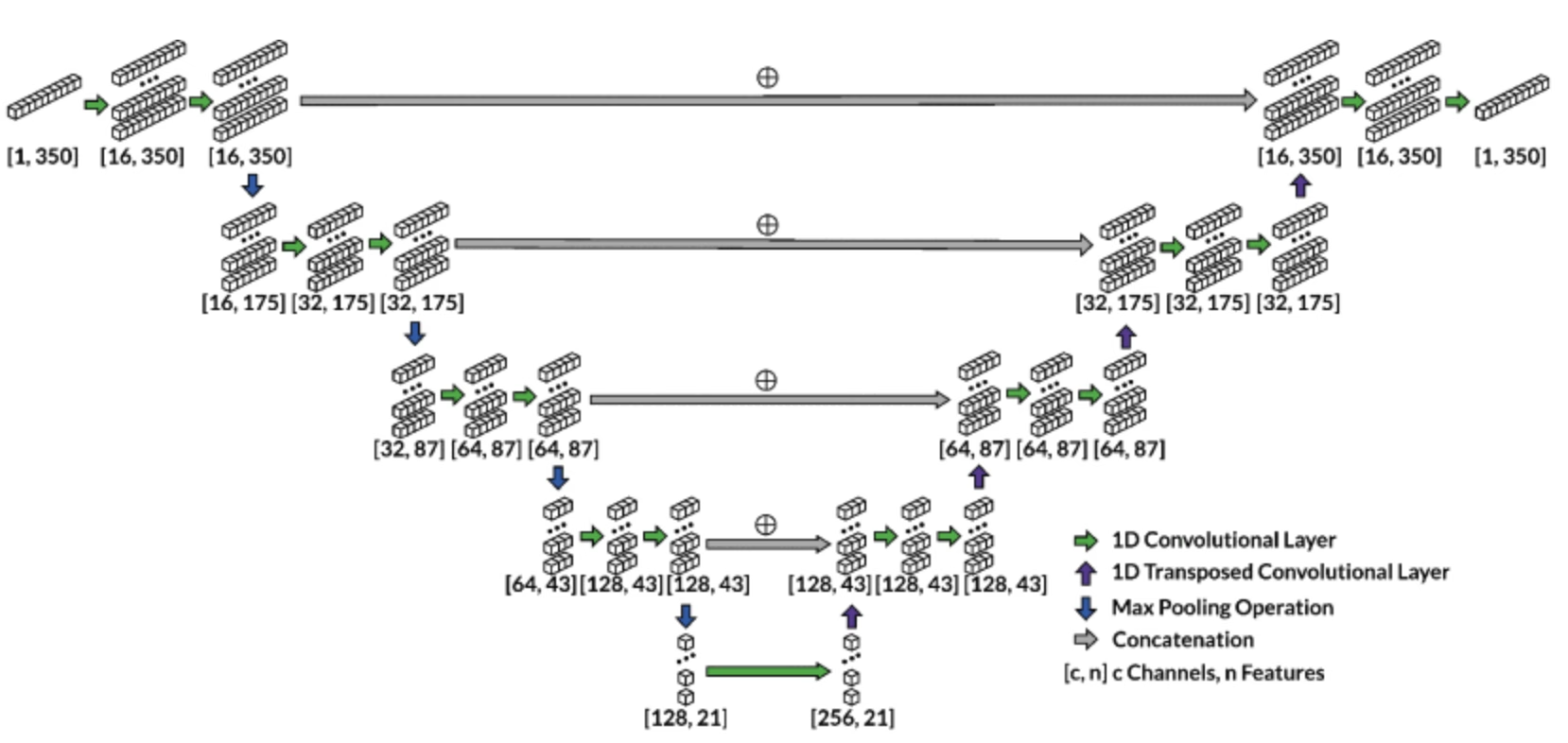
The use of hyperspectral data from the Compact Reconnaissance Imaging Spectrometer for Mars (CRISM) has uncovered a wide range of previously undetected minerals on the surface of the red planet and has been instrumental in the selection of multiple rover mission landing sites. Yet, due to the aging of the sensor and an increase in noise, a significant portion of CRISM data is deemed too degraded and remains unanalyzed. We present a new data-driven model architecture, Noise2Noise for Mars (N2N4M), designed specifically to denoise hyperspectral data. Our model does not require zero-noise target data, making it well-suited for use in planetary science applications where such data does not exist. We demonstrate its strong performance over benchmark methods, outperforming them on most metrics. We suggest that the reliance on spatial correlations in noise profiles for the deep learning (DL) benchmark methods may be part of the cause of their poor performance when applied to CRISM data. We apply our methodology to two case study sites, each previously studied for hydrated mineralogy, and demonstrate that our model can increase the visual clarity of summary parameters used to highlight areas of interest. This has potential impacts for the characterization of landing sites for upcoming missions such as the ESA’s ExoMars rover mission.
Related Posts

An Improved Machine Learning-Based Method for Unsupervised Characterisation for Coral Reef Monitoring in Earth Observation Time-Series Data

Fingerprinting subduction margins using principal component analysis profiles: A data science approach to assessing earthquake hazard
